
B.E Mechanical Engineering
About the Department
Established in the year 2009, with 60 students, the Department of Mechanical Engineering has blossomed a full- fledged state of the art facility, a centre of excellence for Quality Education. Our postgraduate program, M.E. CAD/CAM, introduced in 2011, reflects our commitment to expanding specialized education, with an intake of 18 students. The department boasts modern laboratories such as the Manufacturing Technology Lab, Fluid Mechanics Lab, IC Engines Lab, Heat Transfer Lab, CAD/CAM Lab, Dynamics Lab, and Mechatronics Lab, where students gain hands-on experience, bridging the gap between theoretical learning and practical application.
Department of Mechanical Engineering has young, dynamic and qualified team of faculty and staff members and equipped with state of art facility in all the laboratories. The department is continuously growing in terms of academic, placements, co-curricular, extracurricular activities, projects and consultancy activities. Many of our students are involved in developing the solutions for real time industrial problems and participate in national level and international level competitions and brought laurel to the department.
The faculty in our department are not only dedicated educators but also leaders in research, with numerous publications in prestigious journals indexed in WOS, SCI, and SCOPUS. It has 10 academic laboratories and 1 research facilities with sophisticated equipment to carry out research in the area of Rapid Prototyping, Reverse Engineering, CAD, CAM, Robotics, Machine Vision, Refrigeration & Air Conditioning, Automotive Engineering, CFD, Composite Materials and Industrial Engineering. The department actively engages with higher learning institutions and industries through curriculum development, collaborative teaching & research and consultancy services.
Department of Mechanical Engineering is the one of oldest and broadest among the engineering disciplines. This programme is concerned with the principles of force, energy and motion; this program encompasses the elements of aerospace, electrical, civil, chemical and even material science and bio-engineering along with physics and mathematics. Core subjects such as material science, metallurgy, solid and fluid mechanics, thermodynamics, heat transfer, control, product design and manufacturing processes provide the confidence, ability and flexibility to work in various industries of repute. Mechanical engineers use their knowledge of design, manufacture, and operational processes to advance the world around us, enhancing safety, economic vitality and enjoyment throughout the world. Mechanical engineering is the study of design, development, construction, and testing of mechanical and thermal sensors and devices, including tools, engines, and machines. It focuses the subject which includes automobile engineering, manufacturing engineering, power plant engineering, thermal engineering, and mechatronics engineering etc.
Mechanical engineering is the career center on creating technologies to meet a wide range of human needs. It has roots in the industrial revolution with the advent of the steam engine, automated manufacturing, and the demands of rail, road transportation requiring increasingly innovative and sophisticated engineering solutions. Mechanical engineers work mostly in engineering services, research and development, and manufacturing.
The department regularly organizes seminars, technical workshops and faculty development programmes in cutting edge areas. To enhance the employability skill of the students, department arranges guest lectures, industry supported courses and industrial internships. The students are encouraged to actively participate in various professional society activities like SAE, IEI, ISHRAE, EWB, IWS and various National and International technical contests.
Mechanical engineers work with nature and constitute typically the following task: Understand real-time problems in-depth, analyze and provide viable solution for the problems in the field of manufacturing, thermal and allied fields using modern tools such as, Computer Aided Engineering (CAE), 2D, 3D modeling, solid modeling generated by Computer Aided Design (CAD) in better and easier way. Finite Element Analysis (FEA), Computational Fluid Dynamics (CFD), Digital Manufacturing, Computer Aided Manufacturing (CAM) and Computer Integrated Manufacturing (CIM) are the major technological tools widely used to provide the optimal solution for the real time problems of the industry. In addition, the tool such as Product Lifecycle Management (PLM) is practiced in modern industries in order to manage the entire lifecycle of the product.
The allied fields such as Robotics, Automation, Reverse Engineering, Industrial Ergonomics, Tribology, Mechanical Instrumentation, Aero modeling & maintenance, Textile and Leather machinery manufacturing and maintenance etc., are the major focus areas of mechanical engineering where they have lot of career opportunity.
Program Educational Objectives (PEO's)
PEO1: Apply strong foundations in Mathematics, Science, and Mechanical Engineering to analyze, design, optimize, and implement mechanical systems for industrial and societal applications.
PEO2: Excel as competent professionals, entrepreneurs, or researchers by developing innovative and sustainable solutions in manufacturing, thermal systems, automation, and mechanical design.
PEO3: Demonstrate leadership, teamwork, communication skills, ethical responsibility, and social awareness in multidisciplinary engineering environments.
PEO4: Engage in lifelong learning through higher education, professional certifications, research, and adaptation to emerging technologies such as Smart Manufacturing and Industry 5.0.
Programme Specific Outcomes (PSO's)
PSO1: Design, analyze, and develop mechanical components and systems using principles of engineering design, manufacturing processes, and thermal sciences.
PSO2: Utilize modern engineering tools and software such as CAD/CAM, CAE, CNC, 3D Printing, Robotics, and Simulation platforms to solve complex industrial problems.
PSO3: Develop innovative and sustainable solutions in advanced manufacturing, electric mobility, renewable energy systems, and automation to address real-time industrial and societal challenges.
Vision
To emerge as a Centre of Excellence in Mechanical Engineering by fostering innovation, advanced manufacturing technologies, sustainable engineering solutions, and ethical practices to serve global industrial and societal needs.
Mission
- To deliver outcome-based education through contemporary curriculum, state-of-the-art laboratories, digital learning platforms, and industry-integrated pedagogy in emerging areas such as Smart Manufacturing, Robotics, Mechatronics, Additive Manufacturing, Electric Mobility, and AI-driven Mechanical Systems.
- To equip students with strong technical competence, analytical skills, design thinking, and hands-on experience to enhance employability in core and interdisciplinary industries.
- To promote research, consultancy, innovation, and start-up culture in advanced manufacturing, renewable energy systems, thermal engineering, and automation.
- To strengthen industry–academia interaction through internships, industrial training, live projects, industry certifications, and collaborative research.
- To inculcate leadership qualities, ethical values, environmental consciousness, and lifelong learning to address sustainable global challenges.
Quality Objectives
- To achieve CO–PO attainment levels above the benchmark target (≥ 60%) through continuous monitoring and improvement.
- To enhance placement percentage in core mechanical, automotive, manufacturing, and allied industries annually.
- To increase research productivity through publications, patents, funded projects, consultancy, and prototype development.
- To organize workshops, FDPs, industry-certified programs, and technical events in CAD/CAM, Robotics, CNC, 3D Printing, EV Technology, and Automation.
- To promote student entrepreneurship, innovation projects, and start-up ventures in manufacturing and mechanical domains.
- To establish strong MoUs with industries, manufacturing units, automotive sectors, and R&D organizations.
Maker Space Laboratory
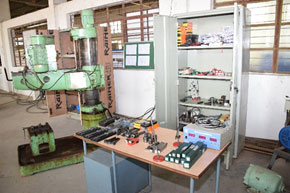
The Maker space Laboratory serves as the department's premier innovation incubator, designed to transform theoretical concepts into tangible solutions. This dynamic, collaborative workspace is equipped with cutting edge rapid prototyping technologies, including 3D printers, laser cutters, and CNC machining centers. It empowers students to embrace a hands-on, iterative design process, fostering a culture of creativity and entrepreneurship. By providing the tools and freedom to experiment, build, and refine prototypes, the lab cultivates critical problem solving skills and cross disciplinary collaboration, preparing students to become pioneers in product development and technological innovation.
CAD/CAM Laboratory
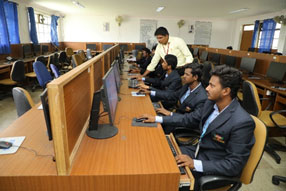
Our CAD/CAM Laboratory forms the digital backbone of modern engineering design and manufacturing education. Within this advanced computing environment, students gain proficiency in industry standard software for Computer Aided Design (CAD), simulation, and Computer Aided Manufacturing (CAM). The laboratory's focus is on the entire digital thread from creating intricate 3D solid models and assemblies to generating precise tool paths for computer controlled machinery. This practical exposure is indispensable, providing students with the skills to drive digital transformation in industries reliant on precision engineering, virtual prototyping, and automated production.
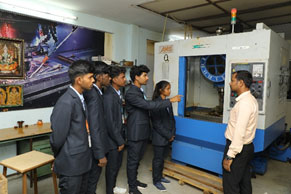
Manufacturing Technology Laboratory-I
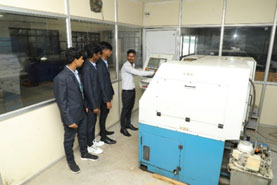
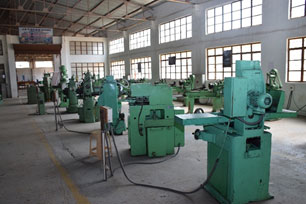
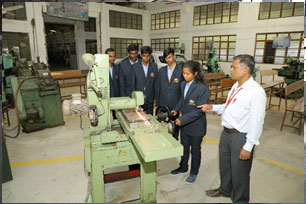
Manufacturing Technology Laboratory-I provides the essential, hands-on foundation in conventional machining processes that every mechanical engineer requires. In this lab, students directly engage with fundamental machine tools such as lathes, shapers, milling machines, and drilling machines. Through practical sessions, they develop a deep, intuitive understanding of material properties, cutting tool dynamics, and the principles of material removal. This foundational experience is crucial for appreciating the evolution of manufacturing and for building the practical competence that underpins more advanced, automated production technologies.
Manufacturing Technology Laboratory-II
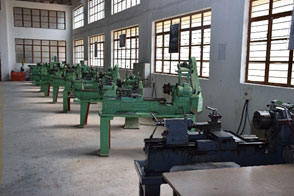
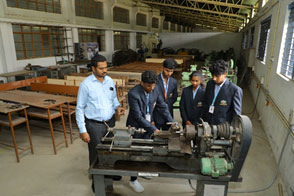
As the advanced counterpart to its predecessor, Manufacturing Technology Laboratory-II immerses students in the realm of modern and nontraditional manufacturing. The lab features sophisticated equipment like Computer Numerical Control (CNC) machine tools, Electrical Discharge Machining (EDM) setups, and advanced welding systems. Here, the focus shifts to precision, automation, and the machining of complex geometries in high strength materials. This laboratory bridges the gap between manual skills and automated production, equipping students with the knowledge to operate and program the sophisticated machinery that is standard in today's high-tech manufacturing facilities.
Thermal Engineering Laboratory
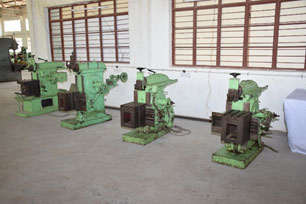
The Thermal Engineering Laboratory is a critical facility where the abstract principles of thermodynamics and energy conversion become concrete reality. Students conduct hands-on experiments with a wide array of power apparatus, including internal combustion engines, steam turbines, refrigeration cycles, and air compressors. By measuring performance parameters like power output, efficiency, and fuel consumption, they learn to analyze and optimize energy systems. This practical experience is fundamental for careers in the power, automotive, and aerospace sectors, providing a deep understanding of how theoretical models apply to real-world thermal machinery.
Heat and Mass Transfer Laboratory
Dedicated to the study of thermal energy movement, the Heat and Mass Transfer Laboratory provides empirical insight into the principles of conduction, convection, radiation, and diffusion. Students work with experimental setups such as heat exchangers, composite wall apparatus, and boiling/condensation units to measure thermal conductivity and heat transfer coefficients. The data gathered and analyzed here is directly applicable to designing more efficient thermal systems, from compact electronic coolers and automotive radiators to complex industrial process equipment, making the lab a cornerstone of thermal design education.
Metrology and Dynamics Laboratory
This integrated laboratory addresses two critical aspects of mechanical engineering: precision measurement and the analysis of motion. The metrology section trains students in the science of measurement, using instruments ranging from basic vernier calipers to advanced laser based and coordinate measuring machines (CMM), instilling a rigorous understanding of quality control and tolerances. The dynamics section, equipped with apparatus for vibration analysis, governor testing, and gyroscopic studies, allows students to explore the forces and motions in mechanical systems. Together, these disciplines ensure our graduates can design, measure, and validate mechanical systems for both accuracy and dynamic performance.
Mechatronics and IOT Laboratory
The Mechatronics and IoT Laboratory is a gateway to the interconnected, automated world of Industry 4.0. This lab blends mechanics, electronics, computer programming, and data connectivity. Students gain hands-on experience designing and building smart systems using programmable logic controllers (PLCs), microcontrollers, a suite of sensors and actuators, and IoT communication modules. By working on projects that involve automation and remote monitoring, they develop the multidisciplinary skills required to create the intelligent, self-diagnosing, and networked machines that are revolutionizing modern manufacturing and smart infrastructure.
Faculty
| Sl.No | Name of the Faculty | Designation | Qualification | AICTE No | AU-COE No. |
|---|---|---|---|---|---|
| 1 | Prof. Dr. Sugumaran C | Professor | Ph.D | 1-3582333921 | 317502 |
| 2 | Prof. Dr. Dineshkumar V | Professor | Ph.D | 1-7742160138 | 258057 |
| 3 | Prof. Dr. Mohan Kumar P | Associate Professor | Ph.D | 1-2183697880 | 284517 |
| 4 | Prof. Anandabharathi K N | Associate Professor | M.Tech..(Ph.D) | 1-10551532190 | 288694 |
| 5 | Prof. Rajaboopathi S | Assistant Professor | M.E | 1-2984060125 | 289447 |
| 6 | Prof. Thamotharan E | Assistant Professor | M.E | 1-3205338240 | 286697 |
| 7 | Prof. Karthick B | Assistant Professor | M.E | 1-4620743815 | 283768 |
| 8 | Prof. Palanivel M | Assistant Professor | M.E | 1-4639163345 | 284947 |
| 9 | Prof. Prabhu M | Assistant Professor | M.E | 1-7436690931 | 286935 |
| 10 | Prof. Jayaraman T | Assistant Professor | M.E | 1-44721946254 | 291589 |
| 11 | Prof. Jayaprakash S | Assistant Professor | M.E | 1-44124620871 | 282504 |
| 12 | Prof. Alexnavanethan R S | Assistant Professor | M.E..(Ph.D) | 1-44720430155 | 282775 |
| 13 | Prof. Sathishkumar R | Assistant Professor | M.E | 1-44720438612 | 284877 |
| 14 | Prof. Mohanshankar M | Assistant Professor | M.E | 1-46616788412 | 324141 |
| 15 | Prof. Manimuthu R | Assistant Professor | M.E | 1-4666717903 | 326203 |
Placement
Coming Soon
Achievements
Coming Soon
Event
Coming Soon