

M.E CAD/CAM
About the Department
M.E. – Computer-Aided Design and Manufacturing (CAD/CAM)
The M.E. in Computer-Aided Design and Manufacturing (CAD/CAM) is a postgraduate program designed to develop advanced expertise in product design, analysis, automation, and modern manufacturing systems. The program integrates engineering fundamentals with state-of-the-art CAD/CAM/CAE tools to meet the evolving demands of smart and sustainable industries.
The curriculum covers advanced CAD modelling, finite element analysis (FEA), computer-aided engineering (CAE), CNC programming, robotics, additive manufacturing, and digital manufacturing technologies. Emphasis is placed on simulation-driven design, optimization techniques, and Industry 4.0 concepts.
Students gain hands-on experience through well-equipped laboratories, research projects, and industry collaborations. The program fosters innovation, technical excellence, ethical responsibility, and leadership skills.
Career Opportunities
Graduates can pursue careers in:
- Design and Manufacturing Industries
- Automotive and Aerospace Sectors
- Automation and Robotics
- Research & Development Organizations
- Product Development Firms
- Academia and Higher Studies (Ph.D.)
Program Educational Objectives (PEOs)
PEO1: Graduates will excel in professional careers in design, manufacturing, automation, and related engineering industries.
PEO2: Graduates will apply advanced CAD/CAM/CAE tools and computational techniques to solve complex engineering problems.
PEO3: Graduates will engage in research, innovation, entrepreneurship, or pursue higher studies such as Ph.D.
PEO4: Graduates will demonstrate leadership, teamwork, ethical responsibility, and effective communication skills.
Program Outcomes (POs)
At the end of the M.E. program, graduates will be able to:
PO1: Independently carry out research/investigation and development work to solve practical engineering problems.
PO2: Write and present substantial technical reports and research publications.
PO3: Demonstrate mastery of advanced CAD/CAM/CAE tools and digital manufacturing technologies.
PO4: Design, analyse, and optimize mechanical systems using modern computational techniques.
PO5: Apply engineering knowledge to solve complex multidisciplinary problems.
PO6: Understand professional ethics and societal responsibilities.
PO7: Function effectively as an individual, team member, or leader in multidisciplinary environments.
PO8: Engage in lifelong learning and adapt to emerging technologies such as Industry 4.0 and smart manufacturing.
Program Specific Outcomes (PSOs)
PSO1: Develop and optimize mechanical components and systems using advanced CAD/CAE tools and simulation techniques.
PSO2: Implement CNC programming, CAM strategies, robotics, and automation in modern manufacturing systems.
PSO3: Integrate additive manufacturing, smart sensors, data analytics, and Industry 4.0 concepts in sustainable production systems.
Vision
To produce highly competent postgraduates in Computer-Aided Design and Manufacturing capable of research, innovation, and leadership in advanced and sustainable manufacturing systems.
Mission
- M1: To impart advanced knowledge in CAD, CAM, CAE, robotics, automation, and digital manufacturing systems.
- M2: To promote research and innovation in design optimization, additive manufacturing, and smart manufacturing technologies.
- M3: To collaborate with industries and research institutions to address real-world engineering challenges.
- M4: To inculcate ethical values, teamwork, leadership qualities, and lifelong learning.
Faculty
| Sl.No | Name of the Faculty | Designation | Qualification | AICTE No | AU-COE No. |
|---|---|---|---|---|---|
| 1 | Prof. Dr. Sugumaran C | Professor | Ph.D | 1-3582333921 | 317502 |
| 2 | Prof. Dr. Dineshkumar V | Professor | Ph.D | 1-7742160138 | 258057 |
| 3 | Prof. Dr. Mohan Kumar P | Associate Professor | Ph.D | 1-2183697880 | 284517 |
| 4 | Prof. Anandabharathi K N | Associate Professor | M.Tech..(Ph.D) | 1-10551532190 | 288694 |
| 5 | Prof. Rajaboopathi S | Assistant Professor | M.E | 1-2984060125 | 289447 |
| 6 | Prof. Thamotharan E | Assistant Professor | M.E | 1-3205338240 | 286697 |
| 7 | Prof. Karthick B | Assistant Professor | M.E | 1-4620743815 | 283768 |
| 8 | Prof. Palanivel M | Assistant Professor | M.E | 1-4639163345 | 284947 |
| 9 | Prof. Prabhu M | Assistant Professor | M.E | 1-7436690931 | 286935 |
| 10 | Prof. Jayaraman T | Assistant Professor | M.E | 1-44721946254 | 291589 |
| 11 | Prof. Jayaprakash S | Assistant Professor | M.E | 1-44124620871 | 282504 |
| 12 | Prof. Alexnavanethan R S | Assistant Professor | M.E..(Ph.D) | 1-44720430155 | 282775 |
| 13 | Prof. Sathishkumar R | Assistant Professor | M.E | 1-44720438612 | 284877 |
| 14 | Prof. Mohanshankar M | Assistant Professor | M.E | 1-46616788412 | 324141 |
| 15 | Prof. Manimuthu R | Assistant Professor | M.E | 1-4666717903 | 326203 |
Maker Space Laboratory
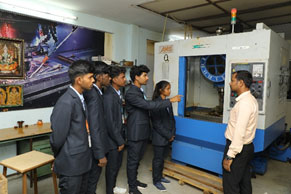
The Maker space Laboratory serves as the department's premier innovation incubator, designed to transform theoretical concepts into tangible solutions. This dynamic, collaborative workspace is equipped with cutting edge rapid prototyping technologies, including 3D printers, laser cutters, and CNC machining centers. It empowers students to embrace a hands-on, iterative design process, fostering a culture of creativity and entrepreneurship. By providing the tools and freedom to experiment, build, and refine prototypes, the lab cultivates critical problem solving skills and cross disciplinary collaboration, preparing students to become pioneers in product development and technological innovation.
CAD/CAM Laboratory
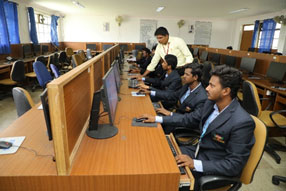
Our CAD/CAM Laboratory forms the digital backbone of modern engineering design and manufacturing education. Within this advanced computing environment, students gain proficiency in industry standard software for Computer Aided Design (CAD), simulation, and Computer Aided Manufacturing (CAM). The laboratory's focus is on the entire digital thread from creating intricate 3D solid models and assemblies to generating precise tool paths for computer controlled machinery. This practical exposure is indispensable, providing students with the skills to drive digital transformation in industries reliant on precision engineering, virtual prototyping, and automated production.
Manufacturing Technology Laboratory-I
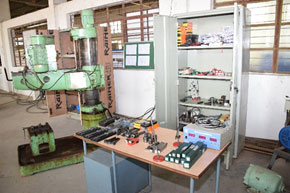
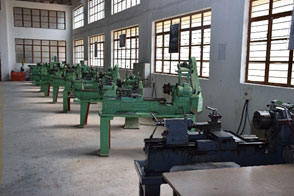
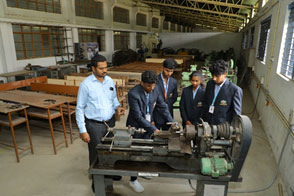
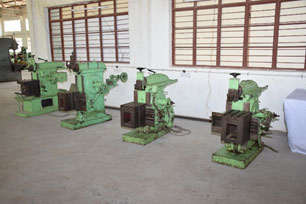
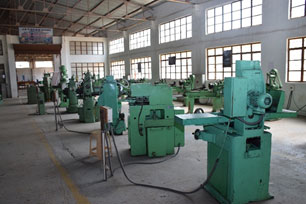
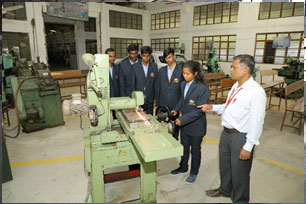
Manufacturing Technology Laboratory-I provides the essential, hands-on foundation in conventional machining processes that every mechanical engineer requires. In this lab, students directly engage with fundamental machine tools such as lathes, shapers, milling machines, and drilling machines. Through practical sessions, they develop a deep, intuitive understanding of material properties, cutting tool dynamics, and the principles of material removal. This foundational experience is crucial for appreciating the evolution of manufacturing and for building the practical competence that underpins more advanced, automated production technologies.
Manufacturing Technology Laboratory-II
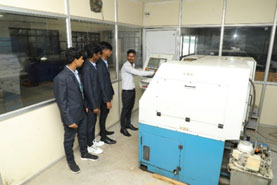
As the advanced counterpart to its predecessor, Manufacturing Technology Laboratory-II immerses students in the realm of modern and nontraditional manufacturing. The lab features sophisticated equipment like Computer Numerical Control (CNC) machine tools, Electrical Discharge Machining (EDM) setups, and advanced welding systems. Here, the focus shifts to precision, automation, and the machining of complex geometries in high strength materials. This laboratory bridges the gap between manual skills and automated production, equipping students with the knowledge to operate and program the sophisticated machinery that is standard in today's high-tech manufacturing facilities.
Thermal Engineering Laboratory
The Thermal Engineering Laboratory is a critical facility where the abstract principles of thermodynamics and energy conversion become concrete reality. Students conduct hands-on experiments with a wide array of power apparatus, including internal combustion engines, steam turbines, refrigeration cycles, and air compressors. By measuring performance parameters like power output, efficiency, and fuel consumption, they learn to analyze and optimize energy systems. This practical experience is fundamental for careers in the power, automotive, and aerospace sectors, providing a deep understanding of how theoretical models apply to real-world thermal machinery.
Heat and Mass Transfer Laboratory
Dedicated to the study of thermal energy movement, the Heat and Mass Transfer Laboratory provides empirical insight into the principles of conduction, convection, radiation, and diffusion. Students work with experimental setups such as heat exchangers, composite wall apparatus, and boiling/condensation units to measure thermal conductivity and heat transfer coefficients. The data gathered and analyzed here is directly applicable to designing more efficient thermal systems, from compact electronic coolers and automotive radiators to complex industrial process equipment, making the lab a cornerstone of thermal design education.
Metrology and Dynamics Laboratory
This integrated laboratory addresses two critical aspects of mechanical engineering: precision measurement and the analysis of motion. The metrology section trains students in the science of measurement, using instruments ranging from basic vernier calipers to advanced laser based and coordinate measuring machines (CMM), instilling a rigorous understanding of quality control and tolerances. The dynamics section, equipped with apparatus for vibration analysis, governor testing, and gyroscopic studies, allows students to explore the forces and motions in mechanical systems. Together, these disciplines ensure our graduates can design, measure, and validate mechanical systems for both accuracy and dynamic performance.
Mechatronics and IOT Laboratory
The Mechatronics and IoT Laboratory is a gateway to the interconnected, automated world of Industry 4.0. This lab blends mechanics, electronics, computer programming, and data connectivity. Students gain hands-on experience designing and building smart systems using programmable logic controllers (PLCs), microcontrollers, a suite of sensors and actuators, and IoT communication modules. By working on projects that involve automation and remote monitoring, they develop the multidisciplinary skills required to create the intelligent, self-diagnosing, and networked machines that are revolutionizing modern manufacturing and smart infrastructure.
Placement
Coming Soon
Achievements
Coming Soon
Event
Coming Soon